Source: Strait News
By Jia Yifang (賈一方)
Nation, page 13
Issue No. 555, Feb 6, 2012
Translated by Zhu Na
Original Article: [Chinese]
This is one of a series of stories from the EO's Feb 6 edition that focused on changes to the regional way of life.
FUZHOU. FUJIAN PROVINCE – Returning to his hometown after years in America, Zhou Qun (周群) noticed something different about the air raid shelters.
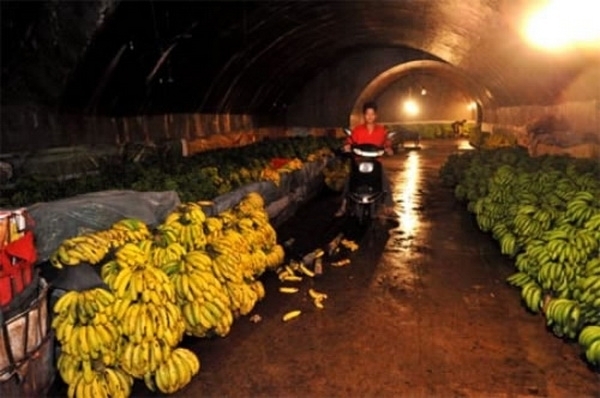
In a sign of the warmer relations between China and Taiwan, the concrete structures designed to protect people from bombs were being used to stores bananas and books.
“The temperature hovers around 25 degrees [Celsius] all year round; it’s perfect for a banana warehouse,” said Zhang Chongyu (張崇于) a banana trader who has been renting the shelters for more than ten years. The disadvantage, he says, is the dampness and the mosquitos that it attracts in the summer.
The first shelters were built in the mid-1960s, when the island across the Taiwan Strait from Fuzhou seemed to pose an imminent threat. The shelters were built to military requirements, meaning that ventilation and lighting were low priorities.
The second phase of construction, during the 9th and 10th Five Year Plans (1996-2005), was part of a civil construction program.
Now that aerial bombardment is off the agenda, the government is quietly mulling over the future of these shelters.
There are at least ten such shelters in Fuzhou says local air defense official Ding Beihua (丁蓓華). Another official, who asked not to be named, said that the commercial use of the shelters is a controversial subject within the government and that many of his colleagues are very sensitive of Fuzhou’s location.
“Some [local government] leaders went on visits abroad and learned from [other countries’] experiences,” said the official, adding that a pilot program was launched, which has spawned Fuzhou Yueyang Book Store (越洋圖書城) and Yueyang Clothes Mall (越洋服裝城) as well as garages and libraries.
It’s expensive to maintain the shelters so that they are capable of functioning during war-time, and, without larger government subsidies, the only way to raise the necessary funds is by leasing them for civilian purposes, said Wu Qiang (吳強), the Director of Fuzhou's Office of Civil Air Defence.
“For example, the Yueyang Book Store can generate 300,000 yuan a year in rent,” said one official, adding that even small sums like this make a difference for the provincial government.
This translation was edited by Will Bland.


