管理員
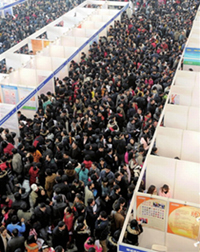 According to Yin Chengji, the spokesman for the Ministry of Human Resources and Social Security, the employment rate for last year's graduates in December of 2010 was 90.7 percent, up 3 percent from the previous year's rate of 87 percent.
But according to a Businessweek article from last September citing figures from China's Ministry of Education, only 72.2 percent of college graduates were employed in 2010. In 2009, the college graduate employment rate was only 68 percent.
These discrepancies underscore recent controversies surrounding official statistics.
A China Economics Weekly article published as early as December 16, 2008, reports on a blue-paper released by the Chinese Academy of Social Science questioning the reliability of the so-called "urban registered unemployment ratio". The report states that China's real unemployment ratio had reached 9.4 percent in 2008, however, the Ministry of Human Resources and Social Security cited the unemployment rate at only 4.2 percent.Why is there such a huge gap in the data? The report quoted Hui Guangping, dean of the economics management college of the Nanjing University of Information Science and Technology, as saying that "the urban registered unemployment ratio" differs from "the surveyed unemployment ratio," and that the latter is more reliable.
The trend continued in 2009 when Southern Metropolis Daily reported that many college graduates confessed online that their universities, in order to boost the employment ratio and to attract more new students, claim they are employed even though they have not yet found a job. According to the report, some universities even forced students to write that they were "employed" before leaving school and withheld their diploma if they refused.
The government as well does its best to make sure graduate employment statistics remain high. In January of 2010, China Daily featured an article titled, "Government helps graduates get jobs." The article quotes deputy-director of the Chinese Talents Society, Chen Jianhui as stating that in order to improve the rate of graduate employment, the government funded around half a million positions to graduates.
With the number of college graduates expected to reach 660 million in 2011, it is almost certain that the trend of dubious employment statistics will continue.
This article was edited by Ruoji Tang
Links and Sources
The Beijing News: 去年應屆生就業率達90.7%
Businessweek: A Dearth of Work for China\'s College Grads
China Daily: Govt helps graduates get jobs
China Economics Weekly: 數據失真 專家建議廢除城鎮登記失業率指標
Southern Metropolis Daily: 網友曝高校幫畢業生偽造就業書 被就業成流行語


 新浪微博網
新浪微博網 豆瓣網
豆瓣網 人人網
人人網 開心網
開心網 轉發本文
轉發本文


